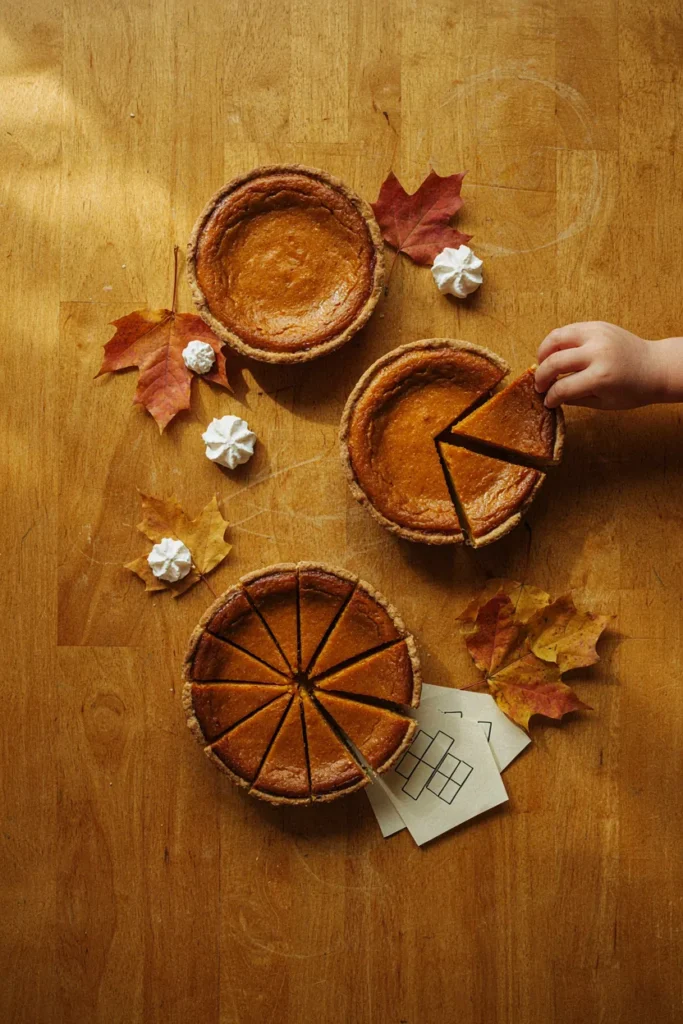
Fractions are abstract. Pie is not. When kids cut a real pie into halves, quarters and eighths, they can see and hold what 1/4 means, and why 2/8 is the same as 1/4. These mini crustless pumpkin pies make the perfect fraction lesson for Thanksgiving week, and every right answer gets eaten.
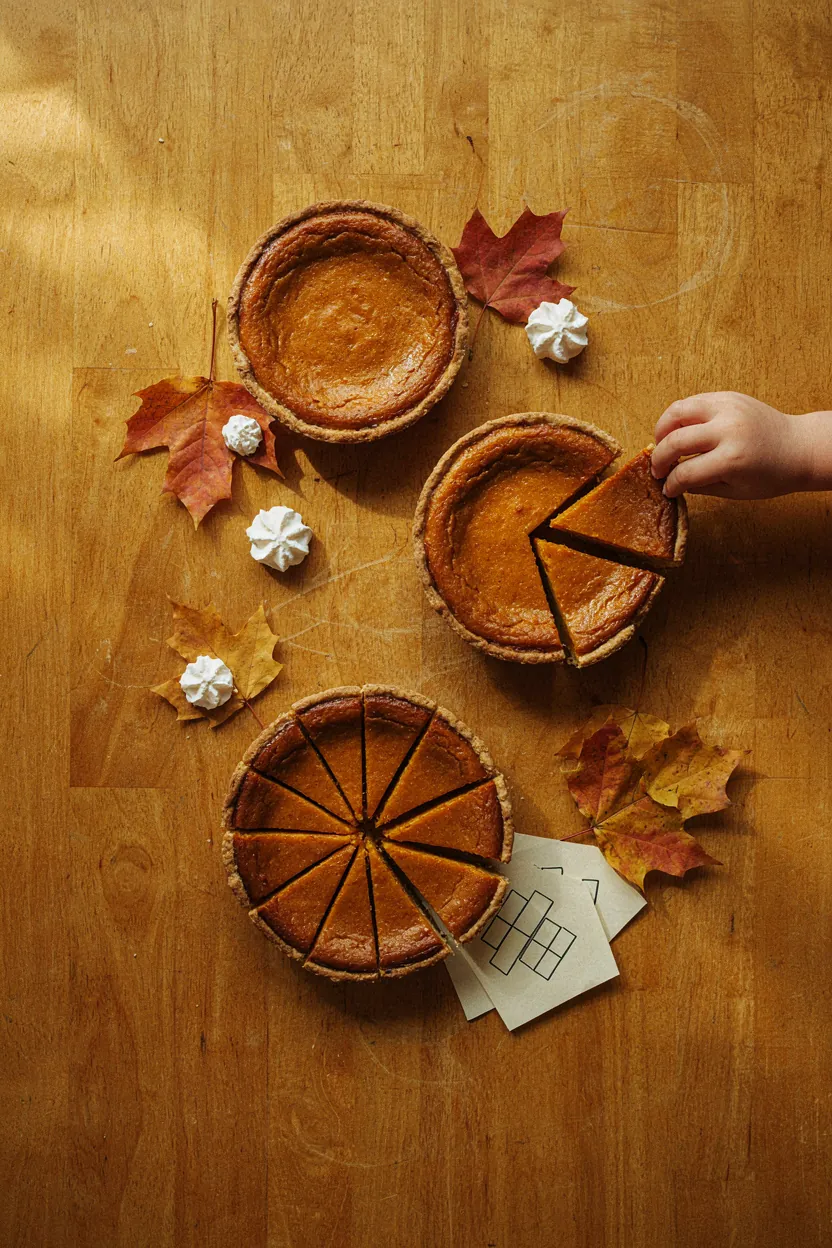
Mini Crustless Pumpkin Pies
Ingredients
Equipment
Method
- Heat the oven to 350°F (175°C) and grease two small pans.
- Whisk everything together until smooth.
- Pour into the pans and bake 30 to 35 minutes, until set with a slight wobble in the middle.
- Cool, then chill at least 1 hour before slicing.
Notes
What Kids Will Discover
Kids learn that a fraction is equal parts of a whole, that more slices means smaller slices, and that different fractions can be the same amount (equivalent fractions).
Ages, Time and Mess Level
- Best for: ages 5 to 10
- Time: 45 minutes, plus chilling
- Mess level: low
- Grown-up job: the oven
The Activity: Pie Fractions
- Cut pie 1 into halves. How many pieces? What is each piece called?
- Cut pie 2 into quarters. Is a quarter bigger or smaller than a half?
- Cut a third pie (or draw one) into eighths.
- Matching game: how many eighths cover one quarter? (2.) How many quarters make a half? (2.)
- Sharing challenge: if 4 people share one pie equally, what fraction does each get?
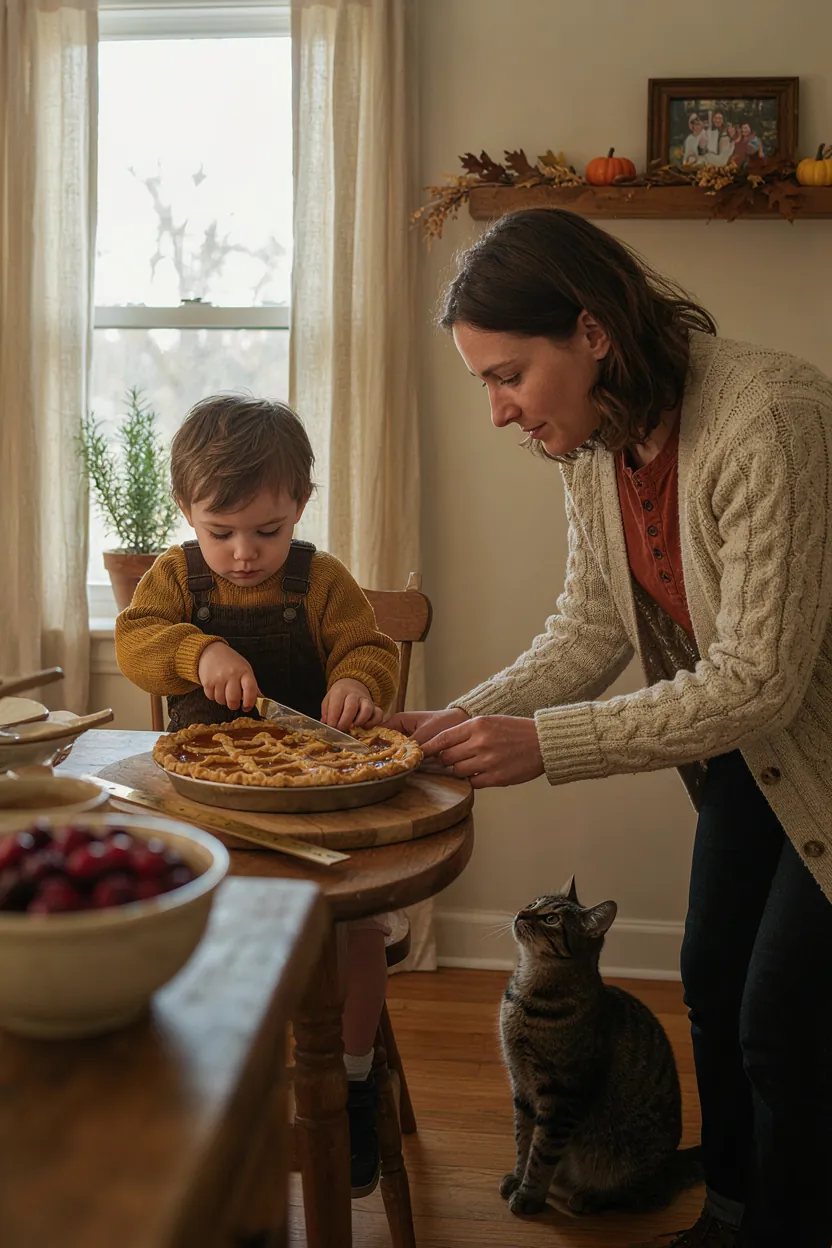
The Math, in Kid Words
A fraction tells you how many equal parts something is cut into (the bottom number) and how many of those parts you have (the top number). 1/4 means “cut into 4 equal parts, and I have 1”. The more pieces you cut, the smaller each one is, so 1/8 is smaller than 1/4, even though 8 is bigger than 4. That surprises lots of kids!
For grown-ups
South Dakota State University Extension highlights the kitchen as a math classroom: slicing food into equal parts is one of the most natural ways to introduce fractions to children.
Change One Thing
- Unequal cuts: cut one pie unevenly. Is each piece still a quarter? (No: fractions need equal parts.)
- Thirds: try cutting thirds. It’s harder than it looks!
- Kitchen chemistry: bake a test batch in our Christmas Cookie Chemistry.
Make It a STEAM Day
- Art: draw and color fraction pies on paper.
- Science: make the Homemade Butter in a Jar to go with dinner rolls.
- More: all our Thanksgiving Science Experiments You Can Eat.
Safety Notes
- Use butter knives for kids; grown-ups handle the oven.
- Contains egg, dairy and wheat (use a gluten-free flour blend if needed).
FAQ
How do you teach fractions with pie?
Cut pies into halves, quarters and eighths and let kids compare and match the pieces.
Is 1/8 bigger than 1/4?
No. Cutting into more pieces makes each piece smaller, so 1/8 is half the size of 1/4.
What are equivalent fractions?
Different fractions that are the same amount, like 2/8 and 1/4.
Can I make pumpkin pie without a crust?
Yes: this recipe adds a little flour so it sets without a crust.
What age is pie fractions for?
About 5 to 10; younger kids count slices, older kids find equivalents.
In Conclusion
Cut, compare, share and eat: pie makes fractions make sense. This Thanksgiving, let the kids slice dessert, and quiz the grown-ups on which is bigger, 1/8 or 1/4.